


Newsletter of the main news 09.11/15.11
All newsDate
15 Nov 2026

- Telegram


1. Frozen Russian assets
Euroclear, the custodian of frozen Russian assets, fears bankruptcy if they are transferred to Ukraine. It holds about €185 billion of Russian central bank assets, over 80% of its balance sheet, so any transfer would require permanent guarantees from EU states. Belgium opposes the plan, while interest income of almost €8 billion has already been directed to Ukraine.
Russia’s assets in the EU will remain frozen until Moscow pays reparations. European Commissioner Valdis Dombrovskis noted that Ukraine will repay the EU’s €90 billion loan only after Russia pays reparations. If it does not, the EU reserves the right to use the frozen sovereign assets.
2. International sanctions policy
The UK has imposed a new package of sanctions on Russia’s energy sector. It covers shadow fleet vessels, coal companies, Rosneft’s Vostok Oil project and Slavneft. The UK thus became the first country to sanction all ten of Russia’s top oil producers.
Canada has imposed new sanctions against Russia. It added 38 entities and 24 individuals linked to the defence industry, including those involved in ballistic missile technology and cyber activity. The measures also target cryptocurrency exchanges that help sustain Russia’s war economy.
Finland has tightened entry restrictions for Russians. They apply to short-term visa employment, including in professional sport, and extend to athletes with “neutral status”. Authorities will take the decision into account when reviewing visa applications from 16 November.
Russia has banned two French MPs and two journalists from entering the country. Moscow was responding to France’s expulsion of propagandist Ksenia Fedorova, former head of RT France. Those banned include a Le Monde journalist who investigated her activity in French media.
The last tanker covered by the US-Russia diesel agreement did not call at an American port. The Agioi Fanendes, carrying 40,000 tonnes of Russian diesel, turned around about 740 km from New York. Under the Trump-Putin deal, the US Treasury had temporarily allowed transactions in sanctioned Russian diesel, with the stated aim of lowering fuel prices ahead of the congressional midterms.
Moldova is stopping its purchases of Russian gas. President Maia Sandu announced this after the launch of the Vulcanesti-Chisinau power line, which connects the country to Romania and the European grid. Moldova was previously almost entirely dependent on Gazprom.
The IIHF has barred the Russian junior national team from the 2027 World Junior Championship in Canada, citing restrictions announced by the Canadian government. The tournament will take place in Edmonton and Red Deer from 26 December 2026 to 5 January 2027.
The International Ice Hockey Federation will appeal the CAS ruling on the reinstatement of the Russian national teams. The appeal is based on undisclosed business ties with Russia of two of the three arbitrators who made the decision.
Two CAS judges who authorised the return of Russian ice hockey players spoke at conferences in Moscow. Italian Giulio Palermo spoke at an arbitration congress on 22 September 2026, and Egyptian Ismail Selim at a similar event in May 2025. CAS said it sees no grounds to question the arbitrator’s independence.
Slovakia’s Minister for Sport has backed Russia’s return to international ice hockey. He said Russian teams “must start” and criticised what he called double standards towards different countries. The TV host who interviewed him took the opposite view.
Russian and Belarusian boxing remain subject to WBC sanctions. The decision was taken at the organisation’s annual congress in Acapulco. After the full-scale invasion began, the WBC removed Russian and Belarusian boxers from its rankings and stopped sanctioning bouts in both countries.
Formula 1 has filed a counterclaim of $104 million against the promoter of the Russian Grand Prix. The promoter, Rosgonki, had earlier sued in the English High Court, demanding £50 million over the race cancelled in 2022. Russia called the claims “legally unfounded”.
3. Violations and circumvention of sanctions
The EU’s Irini mission carried out an inspection of a tanker that may belong to Russia’s shadow fleet. According to Kaja Kallas, the MV Midag, detained on 13 November, was sailing under a false flag. EU foreign ministers were also due to approve new sanctions lists, including companies supporting the shadow fleet.
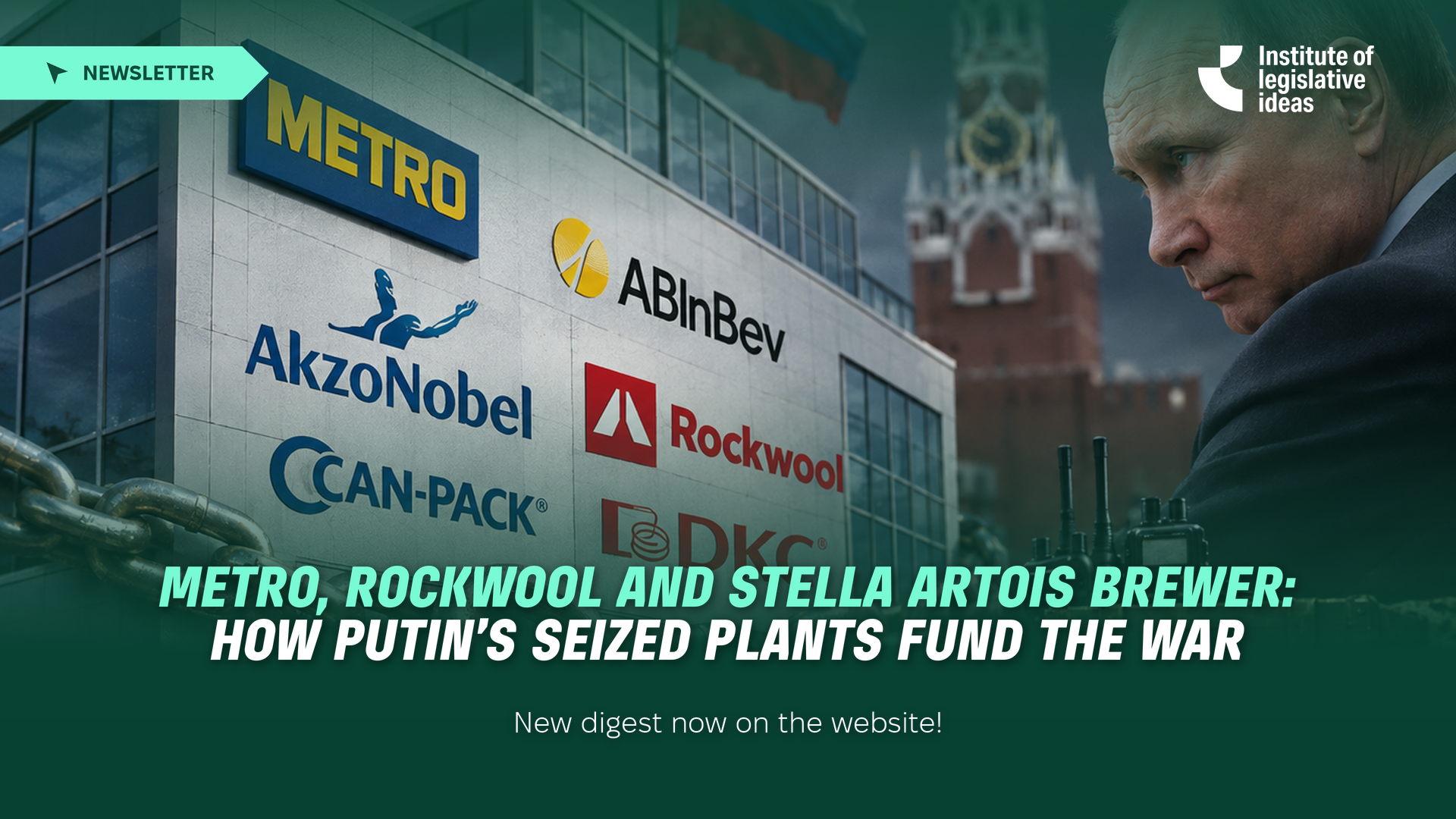
Foreign companies confiscated by Putin are helping to fund the Russian army. According to Bloomberg, Russian units of foreign firms placed under local managers donate billions of rubles to the People’s Front for drones, vehicles and communications equipment. Examples include Rockwool, Akzo Nobel, AB InBev Efes and Metro.
An Estonian resident has been convicted of violating EU sanctions: he brought children’s soap from Russia and tried to take tactical boots there. He received a three-month suspended prison sentence with a one-year probation period. The goods will be confiscated, and he must also pay €1,419 in court costs.
A factory in the EU supplies Russia with raw materials that may be used in weapons manufacture. Ireland’s Aughinish Alumina, owned by Rusal, shipped 491,307 tonnes of alumina to Russia between March and October 2026. EU sanctions do not yet ban alumina exports, and the plant denies any link to military supply chains.
An EU audit has identified problems with the application of sanctions against Russia. The European Court of Auditors found that legal ambiguities and differing approaches among member states reduce effectiveness and create a risk of forum shopping. In 2025 the EU still accounted for about 10% of Russia’s trade, or €58 billion.
A Serbian company, Grindex, supplied metalworking equipment worth €27.5 million to Russia after the full-scale war began. Journalists found that machines reached Rostec enterprises making aircraft components, partly via sanctioned intermediaries. The company itself is not under US or EU sanctions.
Western spirits producers have pulled out of Russia but are increasing their sales volumes. In January-September 2026, Russians bought 51 million litres of foreign-made spirits, 15% more than a year earlier. Brands such as Jameson and Jagermeister reach Russia through intermediaries in third countries and subsidiaries of the producers.
4. Ukraine’s sanctions policy
The Verkhovna Rada has adopted a resolution imposing sanctions on Russian regional deputies. It provides for submitting proposals to the National Security and Defence Council on personal restrictions, including economic measures, a ban on transit and a ban on taking part in privatisation. Regional parliaments are involved in financing the war and in the legislation supporting mobilisation.