


Newsletter of the main news 06.07/12.07
All newsDate
12 Jul 2026

- Telegram


1️⃣ Frozen Russian Assets
A court in Kazakhstan overturned a ruling that had allowed Naftogaz to enforce a $1.4 billion arbitration award against Gazprom, finding that it lacked jurisdiction over the case. Naftogaz said it would continue pursuing enforcement of the international arbitration award in Kazakhstan and other jurisdictions.
2️⃣ International Sanctions Policy
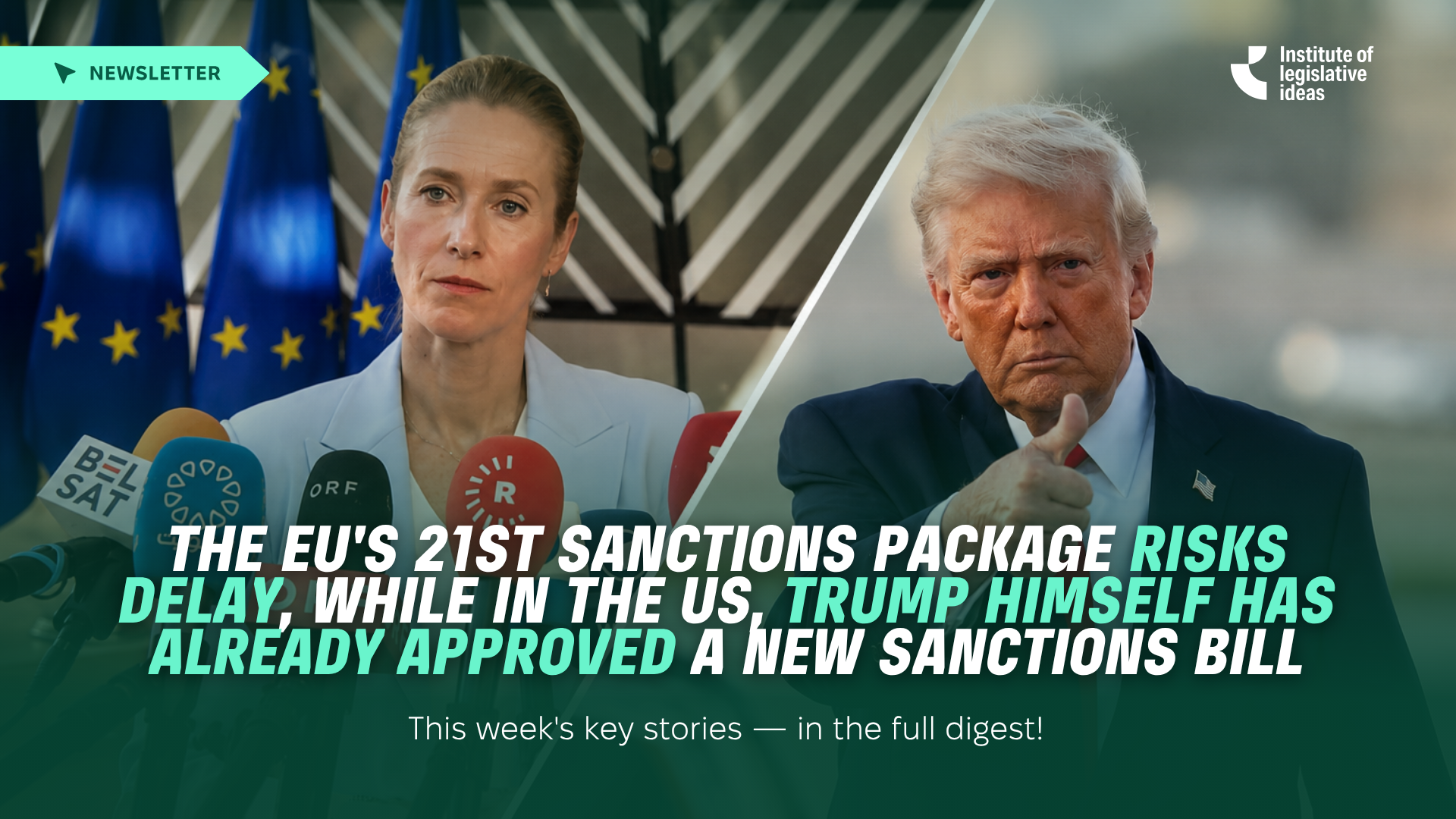
The adoption of the EU’s 21st sanctions package against Russia could be postponed until September if member states fail to resolve outstanding disagreements in the coming days. The main sticking points concern sanctions on Russia’s fishing industry, entry bans for Russian combatants, and individual listings, while the proposed freeze of the Russian oil price cap could be approved separately.
Greek shipping companies have earned at least $3.8 billion over the past three years from transporting Russian oil. According to the Financial Times, they carried around 15% of Russia’s seaborne crude exports in May, benefiting from higher freight rates permitted under the G7 oil price cap mechanism.
Japan has reaffirmed its ban on exports of aviation fuel to Russia, including indirect deliveries through third countries and ship-to-ship transfers. Tokyo said it would further strengthen sanctions enforcement in close coordination with its G7 partners.
Italy’s Minister for Sport opposed allowing Russian gymnasts to compete under the Russian flag at the Rhythmic Gymnastics World Cup in Milan. Although World Gymnastics has lifted restrictions on Russian and Belarusian athletes, the Italian authorities may insist that they continue competing under neutral status.
The International Olympic Committee (IOC) has withdrawn its recommendations that had restricted the participation of Russian and Belarusian athletes since 2022. Decisions on athlete eligibility, the use of national symbols, and hosting international competitions in Russia will now be left to individual international federations, while the IOC will decide separately on Russia’s participation under its national flag at future Olympic Games.
FIFA and UEFA currently have no plans to reinstate Russia in international football. Despite the IOC’s decision to leave eligibility rules to individual federations, Russian clubs and national teams remain suspended from international football competitions.
The OSCE Parliamentary Assembly incorporated the principle of financial accountability for sanctions violations and circumvention into its The Hague Declaration. Participating states were encouraged to direct confiscated assets and sanctions-related fines toward compensation for Ukraine and support for victims of Russian aggression. The proposal, presented by Ukrainian MP Pavlo Frolov, was developed with contributions from experts at the Institute of Legislative Ideas (ILI).
The International Volleyball Federation (FIVB) has approved the return of Russian national teams to international competition starting in 2027. Russia’s teams will regain their previous world ranking points, while a separate decision on competing under the national flag is still pending.
EU officials have called for a review of the IOC’s funding following its decision to withdraw recommendations restricting Russian athletes. The European Commission stated that normalising Russia’s participation in international sport before a just and lasting peace in Ukraine is unacceptable, while some member states proposed suspending financial support for the IOC, including through the Erasmus+ programme.
International wine competitions awarded prizes to wines produced in occupied Crimea as Russian products. Ukraine’s wine industry association warned that such decisions legitimise false product origin claims, undermine international law and sanctions policy, and urged organisers to revise their participation rules.
Poland does not intend to allow Russian volleyball teams to participate in the 2027 FIVB World Championship, despite FIVB’s decision to reinstate Russia. The Polish Volleyball Federation stressed that international sporting decisions cannot override national entry regulations and confirmed that Polish teams will not compete against representatives of the aggressor state.
Members of the European Parliament urged FIFA to reverse its decision to allow Russia to participate in the FIFA U-15 World Cup. MEPs argued that Russia uses sport as a tool of state propaganda and that its return to international competitions is unacceptable while the war continues and abducted Ukrainian children have not been returned.
Russia effectively misled the IOC in order to secure the reinstatement of its Olympic Committee. While the Russian Olympic Committee formally pledged to cease activities in Ukraine’s temporarily occupied territories, Russian officials have since stated that these activities will simply be transferred to the Russian Ministry of Sport.
The White House has approved the final version of a bill introducing new sanctions against Russia. According to Senator Lindsey Graham, the legislation has been coordinated with the Trump administration, significantly increasing its chances of becoming law and providing the U.S. President with additional tools to increase pressure on Russia.
Bulgaria has dropped its threat to block the EU’s 21st sanctions package, but continues to insist on removing Patriarch Kirill, Vagit Alekperov, and several Russian entities from the sanctions list. Sofia argues that the proposed listings could affect energy security, fertiliser supplies, metro maintenance, and its arbitration dispute with Lukoil.
Europe’s leading football nations continue to oppose Russia’s return to international competitions. According to The Guardian, even if FIFA decides to readmit Russian teams, UEFA is unlikely to follow due to strong resistance from England, Germany, France, and other influential football associations.
Patriarch Kirill and Lukoil founder Vagit Alekperov have been removed from the draft of the EU’s 21st sanctions package at Bulgaria’s request. Member states also agreed to soften several other measures, including restrictions on Russian combatants entering the EU, proposed bans on Russian fish imports, and tighter measures targeting Russian LNG.
3️⃣ Sanctions Violations and Evasion
Despite EU sanctions, Russian timber continues to enter the European market through schemes involving falsified certificates of origin. Investigations indicate that intermediaries in China are being used to disguise the timber’s origin, while a sharp increase in larch imports from China, Serbia, and Turkey has raised suspicions that the wood is in fact sourced from Russia.
Russian Iskander-M ballistic missiles contain at least 34 foreign-made components, including electronics manufactured by U.S. and Swiss companies. According to Vladyslav Vlasiuk, missiles produced in 2026 already contain components manufactured in 2025, indicating that intermediary networks and re-export channels through third countries remain operational.
Russian consumers continue purchasing luxury jewellery in circumvention of sanctions through Kazakhstan. Following a collapse in direct exports to Russia, imports of Richemont products into Kazakhstan have surged to tens of millions of dollars, while Cartier items are reaching Russian customers through parallel imports, personal networks, and social media sales.
Russia is establishing a commercial logistics hub at the Syrian port of Tartus, combining civilian trade infrastructure with its existing naval presence. The new hub will handle grain and other goods, including products from Russia and occupied Crimea, strengthening Moscow’s economic influence in the region while creating new sanctions enforcement challenges.
According to The New York Times, Russian intelligence operatives are procuring military-use components in Japan and routing them to Russia through intermediaries and third countries. Operating under diplomatic and commercial cover, they acquire equipment that ultimately ends up in Russian missiles and drones.
4️⃣ Ukraine’s Sanctions Policy
President Volodymyr Zelenskyy imposed sanctions on 38 companies and 57 individuals linked to Russia’s military-industrial complex, missile component production, and Kremlin propaganda. The new listings include manufacturers supplying military aviation and artillery, as well as military bloggers, propagandists, and individuals supporting Russia’s occupation of Ukrainian territory.
Prosecutors have referred to court the case against eight members of a group accused of financing the Russian state budget through businesses operating in occupied Crimea. During the investigation, authorities seized assets worth more than UAH 57 million, while case materials were also forwarded to state authorities to initiate sanctions proceedings against the defendants.